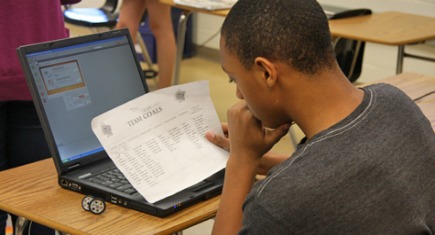
 The National Defense Education Program's Virginia Demonstration Project (VDP) is a science, technology, engineering, and mathematics (STEM) outreach program for middle school students. By increasing students' interest in STEM content, the VDP inspires students to become the next generation of scientists and engineers.
The VDP's objectives are met by teaming scientists and engineers from Naval warfare centers with teacher from schools near base facilities. School division partners for FY 2010-2011 included: Stafford, Spotsylvania, King George, Portsmouth, Accomack, Fredericksburg, Virginia Beach and Norfolk.
In order to ensure both the effectiveness of teams as well as provide program fidelity, a combination of direct professional development training from The College of William and Mary, and for the more advanced programs, master teacher training from school divisions, is provided to scientists and engineers (S&Es), and cooperating teachers. The teacher and S&E then collaborate on the delivery of a high energy curriculum (R2: Relevant Robotics) developed to leverage the efficacy of research-based educational techniques, developed around a Five Strands of STEM Instruction model. The strands of an effective STEM Education are composed of five content and five instructional strands, The VDP combines these strands to provide a best practice approach to STEM education into the K-12 setting. Instructional strands include: Inquiry based instruction, co-teaching, carefully-timed explicit instruction, cooperative learning, and thematic or "Big Idea" classroom framework. Each strand of effective STEM instruction is part of a constant balance to maintain an optimal learning environment or diverse classroom. The content strands consist of mathematics, science, technology, engineering and careers. The presence of the S&E in the classroom serves not only as a career connection and positive role model for students, but as a knowledge resource of the teacher, The S&E makes the previously abstract concept of a career in science or engineering tangible, as well as presenting a career in science or engineering in a positive fashion.
In addition to the classroom program, the VDP coordinates and evaluate summer academies, and provides career resources to parents and secondary school counselors. The VDP makes STEM Explore magazines and STEM career poster sets available to school personnel. work force development organizations, community outreach programs, and education conference attendees. The STEM Education Alliance staff provides STEM career outreach through conference presentations, membership in professional organizations, and an integrated social network service, including a resource-rich website, Face book, and Twitter presence. During FY10-11 the STEM Education Alliance represented the efforts of the National Defense Education Program at 57 meetings and conferences.
2010-2011 Classroom Evaluation Highlights
- After participation in the class portion of the VDP, students indicated that they were more likely to pursue a career in science, engineering, or math than they were prior to the VDP.
- African-American, Other Race, and Female subgroups exhibited larger gains in measures indicating their likelihood to pursue a career in science, engineering or math than either the total analysis sample or other subgroups.
2011 Dahlgren Summer Academy Evaluation Highlights
- Students who participated in the Dahlgren Summer Academy indicated they were more likely to pursue a career in science, engineering, or math prior to participation in camp than the general population of students who participated in the VDP in-school program.
2011 Hampton Roads Summer Academy Evaluation Highlights
- Students who participated in the Hampton Roads Summer Academy were more likely to indicate that they would pursue a career in science or engineering.
- Hap tom Roads Summer Academy participants exhibited larger gains in measures indicating their likelihood to pursue a career in science or engineering than participants in the school year program or participants in the Dahlgren Summer Academy.
2011 Longitudinal Study Evaluation Highlights
- Students who participated in the VDP in middle school in 2005 were surveyed in the spring of their senior year in high school. These students indicated that they were more likely to pursue a career in science, engineering, or math than a comparison group of students who had not participated in the VDP.
For more information or questions regarding our 2010-2011 Annual Report and Evaluation, please contact stemeducation@wm.edu.